
Public Education Forward leads Volkswagen eLabs to provide public school students access to state-of-the-art digital fabrication labs that transform learning and empower students to "make almost anything."

Public Education Forward leads Volkswagen eLabs to provide public school students access to state-of-the-art digital fabrication labs that transform learning and empower students to "make almost anything."

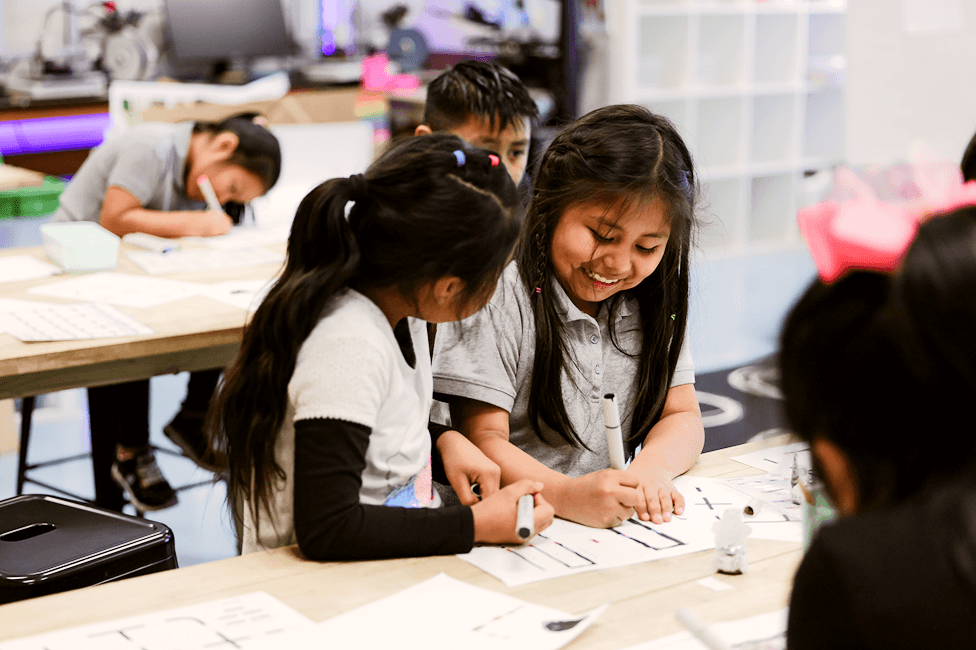
Two elementary students smiling, working on a project assigned by their eLab instructor.

Explore. Engage. Empower.

The unique learning model in VW eLabs offers hands-on experiences with emergent technologies such as renewable energy, robotics, and 3D printing, while elevating student development of Essential Skills like problem solving and communication. By using VW eLabs as a key part of the learning environment, educators empower students, help them learn more effectively, and prepare them for success in a wide range of fields and careers.

Young, elementary students holding a marker, working on a project in a school fabrication lab.

FabLabs and Constructionism


Constructionism is a learning theory that suggests that students are more likely to learn and retain new information when they are actively engaged in constructing their own understanding of the material. In a constructionist learning environment, students are encouraged to take an active role in the learning process, working on projects and activities that allow them to explore and discover new concepts and ideas.


VW eLabs are an ideal setting for constructionist learning, as they provide students with the opportunity to engage in hands-on, project-based activities that allow them to apply their knowledge and skills to real-world problems and challenges. Labs empower schools to provide students with the opportunity to learn through active exploration and discovery with state of the art technology.

FabLabs and Constructionism


Constructionism is a learning theory that suggests that students are more likely to learn and retain new information when they are actively engaged in constructing their own understanding of the material. In a constructionist learning environment, students are encouraged to take an active role in the learning process, working on projects and activities that allow them to explore and discover new concepts and ideas.


VW eLabs are an ideal setting for constructionist learning, as they provide students with the opportunity to engage in hands-on, project-based activities that allow them to apply their knowledge and skills to real-world problems and challenges. Labs empower schools to provide students with the opportunity to learn through active exploration and discovery with state of the art technology.

How it works

Explore

Students are challenged with an authentic problem. Then they use design thinking strategies to explore potential solutions

Engage

Once foundational knowledge is developed, students collaborate and engage with industry experts to develop solution models

Empower

Leveraging digital fabrication technologies, students use rapid prototyping and engineering design processes to create products

Why VW eLabs Work


Our integrated learning model in VW eLabs prepares students for success in a number of ways, including:

  • Developing critical thinking and problem-solving skills: By working on projects and activities in a fab lab, students are challenged to think creatively and critically, and to develop functional solutions to real-world problems.

  • Encouraging collaboration and teamwork: Fab labs were designed to be more than a collection of tools...they also provide access to a network of people who are dedicated to sharing knowledge and building on the work of others in a global community. In schools, students use this same idea to engage with a broad range of people as they work together to bring their ideas to life!

  • Providing real-world relevance: Working on projects in a fab lab helps students see the relevance of their learning to the real world. Rather than isolating learning to trivial problems focused on memorizing theories, labs empower teachers to make the learning tangible and to help students make their thinking visible. As an added byproduct, student engagement radically increases.

  • Fostering creativity and innovation: Fab labs and constructionist learning environments encourage students to think creatively and to explore new ideas. Leveraging access to computer controlled tools, a network of experts, and brilliant teachers, student experience increased innovation and develop strong problem-solving abilities.

Workforce Development

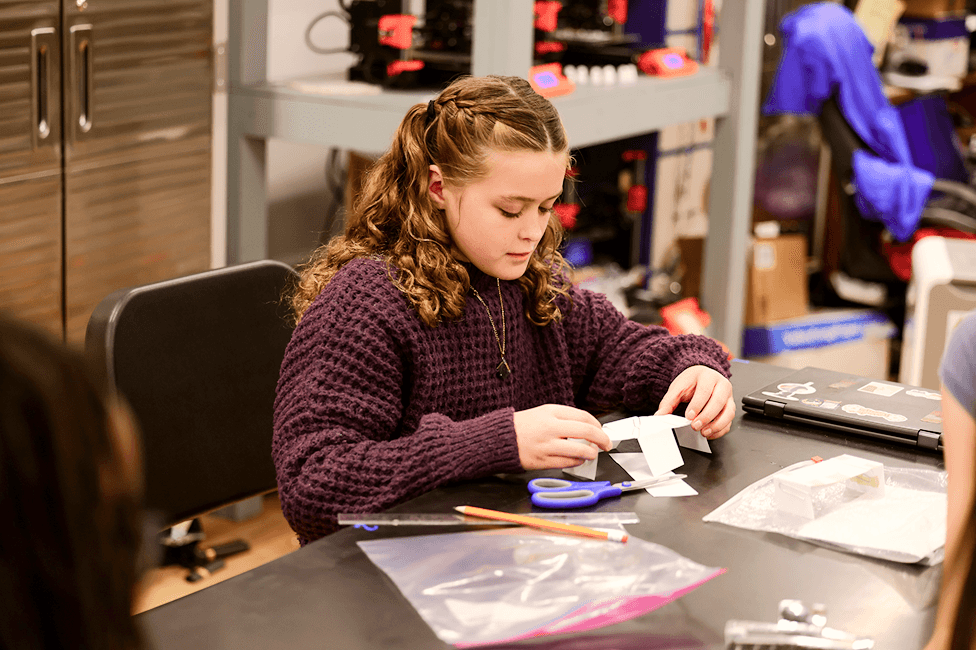
Fab labs are more than just high-tech workshops; our learning model, developed out of STEM School Chattanooga with the Public Education Foundation and Hamilton County Schools, leverages labs as a mechanism for students to gain valuable technical and essential skills that prepare them for success in the modern workforce. Here are just a few examples of how students are using VW eLabs to gain an edge in their careers:

  • Engineering students are using labs to prototype and test new designs for electric vehicles and other advanced technologies. By working with real-world materials and equipment, these students are gaining practical experience that will be valuable in their future careers.

  • Data science students are using fab labs to analyze and visualize data generated by computer-controlled machines, such as 3D printers and CNC milling machines. By learning how to interpret and present data, thesestudents are developing valuable skills in data analysis and visualization, which are in high demand in many industries.

  • Entrepreneurship students are using fab labs to prototype and test new ideas for products and services. By working on real-world projects in a FabLab, students are experience product development and market research, which can help them succeed in a wide range of sectors and industries.

You have Questions

We have the Answers

Have more questions? Don't hesitate to email us.